
PLANNING YOUR EVENT
Choose a game
people want
to join.
Start with what visitors will do: match a pair, beat a score, explore a world or play together. Then choose the artwork, controls and event setup around that action.
This guide is for brands and agencies planning an activation in Bahrain. ALT Studio develops branded games and interactive experiences from our studio in Seef.
What should visitors enjoy doing?
A walk-up game needs a clear invitation. Before choosing a visual style, decide how much attention the game should ask for and whether people will play alone or together.
- A quick turn: choose an action someone can understand by watching the previous player. Memory Match is a familiar starting point: turn over cards and find pairs.
- A little competition: give players a skill to improve and a result they can compare. Precision Drive combines a circuit, coin collection and obstacles.
- Product discovery: build the game around objects or details worth noticing. Card faces, clues and collectible objects can introduce a collection or theme.
- Playing together: choose rules that give each person something to contribute. Bridge Keepers explores two players balancing one bridge.
We agree the session length, instructions and reset with the event brief. A leaderboard, multiplayer setup or prize flow needs its own rules and testing.
What is the difference between 2D and 3D games?
2D describes flat graphics and screen-based actions. 3D describes depth, environments and objects within a game. Both can be shown on an event screen. The visual format does not determine the controller, and 3D does not automatically mean VR.
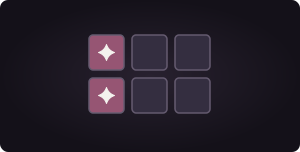
2D: a clear action.
Match cards, react to a signal, trace a shape or solve a puzzle. A graphic treatment can put products, colours and campaign artwork directly into the activity.
Explore 2D games ↗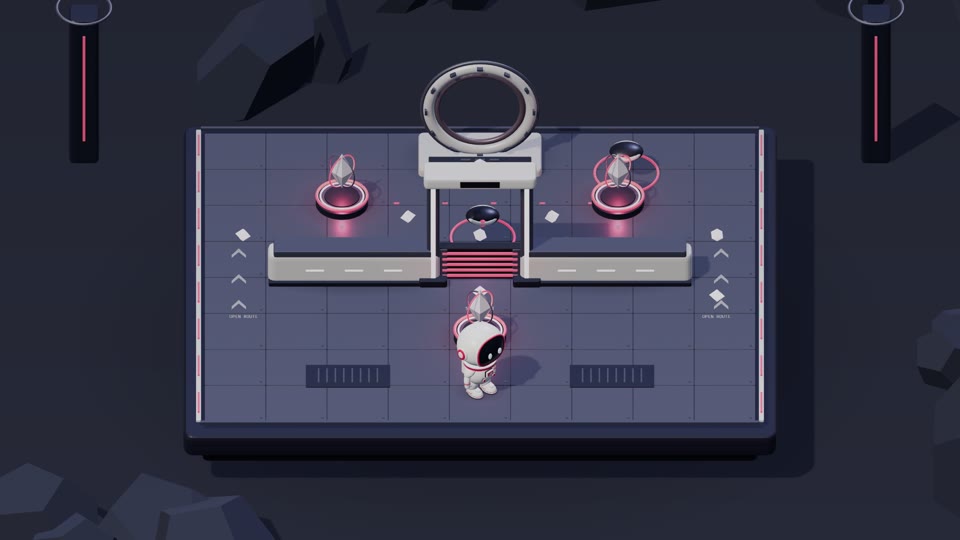
3D: a world to play in.
Steer around a circuit, explore an environment, aim at moving targets or place objects. The setting, movement and camera help explain the experience.
Explore 3D games ↗Our demo films show the game idea, play sequence and finish. Your commissioned version is scoped around the artwork, controls, rules and equipment you need.
Choose the controls separately.
- Touchscreen: tap or drag directly on the game. The display must support touch, with a layout and reach suited to the players.
- Joystick and buttons: give the game a physical arcade feel. We map the controls to the game and test movement, selection and button actions.
- Motion or detection: use a deliberate gesture or body movement. Tracking, lighting, camera position, accessible alternatives and clear player space need to be considered.
- Phones: players can open a browser game by link or QR code. Using phones to control a shared screen is a separate setup, with joining, connection and turn-taking to develop.
Controls are adaptations to assess with each game. A demo of a controller on the website does not mean every game already supports it.
Try the control demonstrations ↗What can follow your brand?
For a 2D game, the card faces, objects, colour palette, instructions and result screen can carry your identity. For a 3D game, the environment, objects, signs and finish can be developed around your theme.
A rebrand should still be easy to play. Players need to recognise targets, understand feedback and read the result. We work through those details alongside the visual treatment.
We can also discuss portrait or landscape screens, an arcade station, or a winning moment connected to surrounding screens, lights and sound. Equipment, integration and installation are agreed for the chosen setup.
See how branded touchscreen games work ↗A good finish. Clear reward rules.
A game can finish with a score, a completed challenge or a celebration. A physical prize is a separate decision: agree who qualifies, whether a player can try again and how the event team will handle redemption.
Registration, personal-data handling and prize distribution are scoped separately from the playable game. If you need them, we agree what information is collected, why it is needed, who can access it and how long it is retained. The entry and prize rules should be clear to players before they begin.
You can also plan an experience that does not ask visitors to register. We will discuss the appropriate flow for your event.
What should you send us?
An early brief is enough to start a useful conversation. Include what you know:
- The event, audience, location and date.
- What you want visitors to do or take away.
- A game or two you like from the directory.
- The space, screens and equipment already available.
- Your brand assets, language needs and preferred controls.
- Whether you need registration, scores, prizes or connected lights and screens.
ALT Studio works with agencies and direct clients. We will use the brief to recommend a direction and agree the development and delivery scope.